|
|
Review of the Mackie HR 824 by Rich the TweakMeister
Overview
Like all monitors, the Mackies have a unique sound. Nothing else sounds exactly like them, though many come close. Naturally, when we talk about the sound of a monitor we are going to have to get subjective. Here's how the Mackie's sound to me. Your ears may vary. The overall sound Compared to most speakers the 824s have a clarity to them that other lesser monitors cannot touch. The upper range of frequencies shine through with no artifacts and with a clear sound you may be unaccustomed to. This becomes even more evident when one listens to the vocal range of frequencies. Vocals are more than alive and well. You can hear nuances you did not hear in the original recording. And the vocal frequencies sound uncommonly smooth and pronounced---yep, vocals seem louder, than they are on "average speakers". The bass, which is powerful thanks not only to the 8 inch woofer but to an internal passive radiator, can get very low. Not as low as a subwoofer can go, but deep enough where having a subwoofer may not be so important, or a distraction. Comparing the bass response of the HR824s to a subwoofer enhanced system is illuminating. The lowest frequencies, say, 20-40hz range roll off rather quickly on the Mackies even at it's lowest settings. What this means is that the lowest of the lows are not going to be heard. As you bring in a subwoofer, bass takes on a dimension that is absent in the HR824 by itself. But the bass you do hear is solid and tight, strong, but not boomy, at least in my studio.. You will not be mistaking a low F for an F# as you might on lesser monitors with less bass. But if you need "all" of the bass, then you probably should go for a sub enhanced system, or perhaps add the Mackie Subwoofer to the HR824s. There is a 3-way bass roll off switch on the back which has points at 37hZ, 47hZ and 80hZ. If you want to add a sub, naturally, you would choose the 80hZ. Another advantage of this switch is you can have the Mackie's emulate a smaller monitor.
Are the Mackie's the Perfect Reference Monitor? The true irony of any exceptional monitor is that the better it sounds, the less you tweak your mix. Why? Because what you hear coming out of the Mackies is excellent. Is this a problem? No and yes. No, because you can hear imperfections in your tracks with great clarity. You are unlikely to let by any damaged audio because it will be sticking out plain as day. Yes, because great sound is deceptive. Here's some areas where the Mackie's might actually deceive someone at mixdown. Vocals With such great clarity in the vocal range, it is easy to put a track to bed with little hi frequency enhancement. You sense it does not need it. However, when you reference on your less adorned monitors you might find the vocal dull and more buried. After a day working my most recent mix and feeling I had it in the can, I burned a CD and took it to the living room to listen on my old bookshelf speakers. Shock, it sounded awful. So back in the lab I ramped up the hi freq EQ and killed the reverb. This made the vocal sound "edgy" on the Mackies. But it made the living room mix sound "right". I then went around the back of the Mackie and set the high frequency contour to -2. This seemed to help give the 824's a more "real world" transient response. Imaging They are not kidding when they say the Mackies have a large sweet spot. All you have to do is A/B them with other monitors in your studio and this will become obvious. The image of the 824s is incredible. It has a huge "center stage" that makes other monitors sound "narrow". Again, there is some risk of deceiving yourself that you have a wide and spacious mix when in the real world, you don't. I found I had to go through a spatial processor to get the living room mix as wide as I wanted it Bass One thing about the 824's bass--it is quite powerful and clean. I am happy to report that it actually helps me get the troublesome bass level set properly. I also found that a moderate bass level on the Mackies translated to a strong bass on my other monitors. If I were to mix up a strong bass on the Mackies my other speakers got boomy. This is no doubt due to the fact that the Mackies can handle strong bass tones without breaking up. While other monitors may pop their woofs and wheeze out their ports, the Mackies simply remain tight and solid. Once I got used to that and compensated by not tweaking in too much bass, I found that my mix sounded right on both subwoofer enhanced systems and on bass-shy speakers. I am finding this is superior to mixing with subwoofers. Why? When you mix with subs it's easy to have great bass definition that does not translate at all to bass shy speakers. Lets take timpani for example. Mixing with a subwoofer, its really easy to get a thundering tone, that blasts deep into your internal organs. Yet on a small speaker system, it turns to a metallic-like cardboard box sound. Mixed on the HR824's you'd never hear that really low thunder tone like it is on the sub so you'd boost the lo freq of the timpani. This adjustment makes it sound perfect on a bass shy monitor and awesome on a subwoofer. This is just to say that the roll-off of low frequencies where they are can make for a better, more universal bass mix. (Mackie claims the HR824 is flat down to 39hZ where a typical subwoofer will be able to reach down to 30, 25 and even 20hZ). There is a switch that effects bass response on the back that has settings for placing the 824's in corners and flush against the wall. These settings attenuate the bass to compensate for the room's exaggeration of bass frequencies. I did not need it, but it is nice to know it is there.
The true test of a reference monitor is: Does an excellent sounding mix translate to other systems? The answer, as you should have guessed by now is, it depends. It depends on your experience. I have already learned that I need to notch up hi frequencies to get a vocal to sit up properly on my other systems. I've learned not to push the Mackies on bass. I have learned not to trust the spacious, luxurious Mackie sound as the end point in the game. This is not a deficiency but a rite of passage one has to go through with any monitor
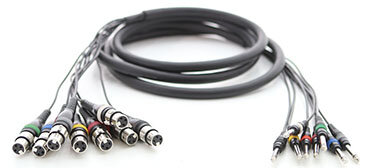
Other issues Power You can read specs all day, but you won't have an idea of how powerful the monitors are till you hook them up to your gear. I have mine connected to the control room outs of my Behringer MX9000 which outputs a +4 unbalanced line level signal. Set to full normal operation, the Mackie's were extremely loud at the center position of the control room pot. I turned down the Mackie's input sensitivity to -10. Now the level is moderately loud at 50% and I usually mix at 30% which is a comfortable level. The Mackie's sound good both loud and soft. One has a feeling that there are immense spare power resources under the hood. For those that want specs, the bass driver can produce 150 watts continuous (or 350 watts peak) and the hi frequency driver produces 100 watts continuous (or 210 watts peak). That's plenty of juice for any home studio There are many ways to connect the Mackies. Options on the HR 824 include XLR (mic cables), 1/4 phone (you can use both balanced or unbalanced cables on these jacks) and RCA for home stereos. tape decks, DJ gear, etc. Are they Nearfields or MidFields? I have my 824s positioned 4 feet away in the typical equilateral triangle. I certainly would not want them any closer than that. I am confident they would work well 5 feet away and sound awesome. Placing them further out, as is the case with all monitors, will bring in more "room sound". If you consider 4 feet to be a nearfield then that's what you have. My other near fields are stationed 3 feet away and my mid- fields are 5 1/2 feet away.
Summing it all The Mackie HR824 monitors are beautiful sounding monitors. They sound great enough to be used in not only as mix-critical reference monitors but as living room audiophile speakers. As one expects from Mackie products, they appear to be rugged and reliable and nicely designed. You will definitely hear your mix with astonishing clarity in all frequency regions with no artificial hype coloring your hearing. And you'll have a monitor that can outperform most other speaker systems an average person might have. If there is any fault at all to the Mackie's it is that they sound too good and your ear may be deceived into thinking this goodness will translate to other, lesser systems. But that is your job to figure out how things translate. Their job is to present you with your sound in all its fullness. They did their job well.
All the best, Rich the TweakMeister Want to comment on this article? Go to the studio monitors and amplification forum
|